By Caribo Magazine
In Buenos Aires, people don’t meet “by chance.” They meet because the city makes it likely.
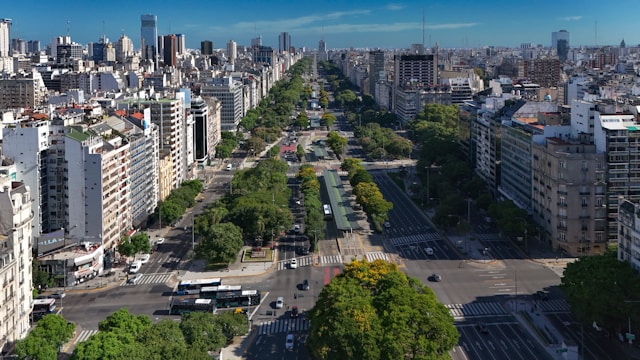
The first impression, for anyone crossing it without preparation, is that of a geometry that allows no hesitation: a regular, almost stubborn grid in which streets repeat themselves with a coherence that removes ambiguity. Avenidas run like main axes, calles follow one after another according to a logic that does not need to be interpreted. It is a city designed to be traversed rather than deciphered.
The urban grid as social organization
For students, this urban feature becomes more than an aesthetic detail. It becomes a form of social organization.
Moving through Buenos Aires means being able to arrange meetings without the uncertainty typical of many European organic cities, where streets bend, break, and overlap. Here, the urban structure reduces distance not only physically but cognitively: orientation does not require mediation. And this changes the way people meet.
In many cities, a meeting is an event shaped by continuous negotiation: where you are, how you get there, how much time you lose, which route you take. In Buenos Aires, especially in student life, the meeting becomes almost a linear function of the urban system. It is no longer a fragile point in the day, but a predictable passage within a stable network.
Legibility and student trajectories
University faculties, scattered across different neighborhoods but connected by this regular grid, are inserted into a field where movement is always legible. Students do not need to “discover” the city every time they move through it: they reactivate it. And in doing so, they keep open the possibility of intersecting other trajectories.
This produces a specific effect on social life: the city does not only enable appointments, it makes them reversible. A meeting can be shifted, delayed, extended without losing structure. It is not exception that organizes urban life, but repetition.
Avenidas the corridors of convergence
Even the corner café, the neighborhood bar, and the small kiosks at intersections like those along Avenida Corrientes or Avenida Santa Fe become predictable nodes within a larger system. Not special places, but potential points of convergence.
Corrientes itself—running for roughly 8 kilometers through the city, crossing the historic center and the theater district—acts as a continuous corridor of encounter, especially between students, bookshops, and nightlife. Santa Fe, extending for about 12 kilometers, connects dense residential zones with commercial and university areas, quietly structuring daily student movement. And Avenida Rivadavia, one of the longest in the world at nearly 35 kilometers, cuts across the entire metropolitan fabric, linking the city center to distant western districts, turning distance into something consistently negotiable.
Landmarks as intensified social points
In this sense, places like Plaza de Mayo, Palermo’s Plaza Serrano, or the university corridors around Recoleta and Avenida Córdoba are not isolated landmarks. They behave like intensified points along these axes—moments where the grid becomes visible through social concentration rather than architecture.
For students, this leads to a simple but decisive condition: there is no need for excessive planning in order to meet. One only needs to move within a system that already contains encounter as a structural possibility.
And so, while in many cities meeting someone is often the result of logistical effort, in Buenos Aires it appears as a secondary effect of urban form itself. Not something constructed, but something that emerges. In the end, this is the true nature of its grid: it does not only organize space. It organizes the minimal amount of time required for two people to find each other without either of them truly having to search.
DWS Spanish School was founded in 1998 by Annabella Yagust and is located in the Recoleta neighborhood of Buenos Aires, one of the principal cultural centers of the Argentine capital.
DWS Spanish School was founded in 1998 by Annabella Yagust and is located in the Recoleta neighborhood of Buenos Aires, one of the principal cultural centers of the Argentine capital.