By Caribo Magazine
Some places are beautiful because of what they offer to the eye. Others become memorable because they change the way we look at the world around us.
Purmamarca belongs to the second kind.
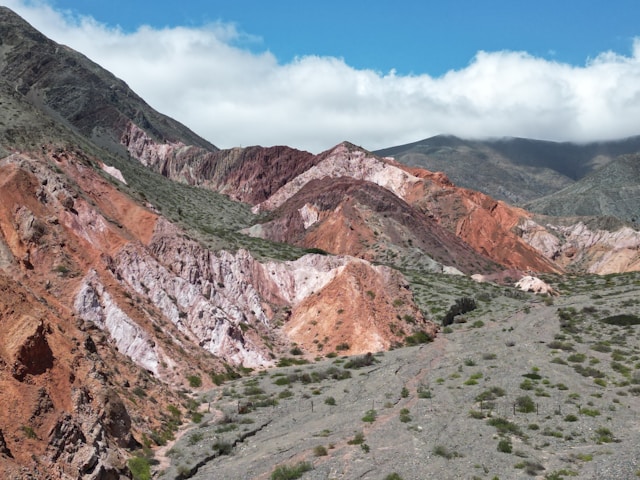
In the province of Jujuy, in north-western Argentina, this small village stands at the foot of mountains whose extraordinary colours seem almost too vivid to be natural. Shades of red, ochre, orange, green and violet run through the surrounding landscape, creating one of the most distinctive visual identities of the Argentine Andes.
Yet Purmamarca is more than a spectacular backdrop for photographs.
Its landscape is inseparable from its history, its architecture, its traditions and the communities that have inhabited this part of the Andes for centuries. To understand the village, it helps to resist the temptation to see it simply as a destination.
Purmamarca rewards a slower gaze.
A Village in the Quebrada
Purmamarca lies in the Quebrada de Humahuaca, a mountain valley that has served as a route of movement, exchange and cultural encounter for centuries.
The village itself remains relatively small. Its low adobe buildings, narrow streets and central square create an urban landscape that feels closely connected to its surroundings. Here, architecture does not attempt to compete with nature. It responds to it.
Adobe, traditionally made from earth and other natural materials, is particularly well suited to the region’s climate. Thick walls help moderate the considerable difference between daytime and nighttime temperatures, while the use of local materials gives the buildings a visual continuity with the landscape.
The result is a village that seems less imposed upon the mountains than embedded within them.
That relationship is one of the keys to understanding Purmamarca.
The Hill of Seven Colours
The Cerro de los Siete Colores — the Hill of Seven Colours — is undoubtedly the image most associated with Purmamarca.
Its remarkable palette is the result of geological formations and layers of different minerals accumulated over immense periods of time. What appears from a distance almost like an abstract painting is, in fact, a geological record.
But the mountain changes according to the light.
Early in the morning, its colours can appear subdued and almost delicate. As the sun rises, the reds and ochres become more pronounced. Clouds, shadows and the changing position of the sun continually alter the landscape.
The mountain itself remains still.
Our perception of it does not.
This is perhaps why the Cerro de los Siete Colores is so difficult to reduce to a photograph. The image records a moment, while the landscape is constantly becoming another image.
The Landscape Is Not Empty
There is a particular danger in looking at the Andes from a distance: the impression that an immense landscape must also be an empty one.
It is not.
The Quebrada de Humahuaca has been inhabited and crossed for thousands of years. People, animals, goods, languages and ideas have moved through these mountains long before the emergence of the modern Argentine state.
The region later became part of the Inca world and was subsequently incorporated into the Spanish colonial system. Each period left traces, sometimes visible in architecture and archaeological remains, sometimes preserved in traditions, place names and ways of life.
Purmamarca therefore exists within several layers of history at once.
The landscape may appear timeless, but it is not.
It is the result of countless human journeys.
The Plaza and the Market
At the centre of village life is the main square, where local traditions and contemporary tourism meet.
The market offers textiles, ceramics, jewellery and handicrafts whose colours often echo those of the surrounding landscape. For visitors, these objects may initially appear to be souvenirs. Yet many are connected to regional techniques, materials and aesthetic traditions.
This creates a question that is particularly interesting in a place like Purmamarca:
When does a cultural object become a souvenir?
Tourism inevitably changes the places it discovers. It creates economic opportunities, but it can also transform traditions into commodities and reshape the way a community presents itself to outsiders.
Purmamarca does not exist outside this tension.
It is precisely because the village has become internationally recognisable that the relationship between local identity and tourism deserves attention.
A Landscape of Languages
For anyone learning Spanish in Argentina, Purmamarca offers another kind of lesson.
Spanish is the dominant language of everyday communication, but it exists within a much older and more complex linguistic landscape. The cultural history of the region includes Indigenous languages and traditions, particularly those associated with the Andean world.
This reminds us that learning a language is never simply a matter of memorising vocabulary and grammar.
Language carries geography.
It carries memory.
It carries traces of migration, conquest, exchange and cultural survival.
Even a place name can preserve a fragment of a history that predates the modern political borders surrounding it. The meaning and etymology of Purmamarca itself have been interpreted in different ways, which is a useful reminder that linguistic history is rarely as simple as a dictionary definition suggests.
To learn Spanish in this part of Argentina is therefore also to encounter a multilingual cultural history.
Food as Geography
Food offers another way into the culture of the region.
In Jujuy and the wider north-western Andes, local cuisine reflects both the possibilities and the limitations of the highland environment. Corn, potatoes, quinoa and peppers are among the ingredients associated with regional cooking, while dishes such as empanadas, tamales and humitas connect contemporary meals with longer culinary traditions.
Food, however, is never only about taste.
It reflects what a landscape can produce, what communities have learned to preserve and what different cultures have exchanged over time.
A traditional dish can therefore be read almost like a historical document.
It tells us something about climate, agriculture, movement and cultural contact.
A Different Sense of Time
Perhaps one of the most striking aspects of Purmamarca is its rhythm.
Compared with Buenos Aires and other major Argentine cities, the village offers a radically different relationship with movement and time. The streets are quieter, the buildings lower, and the mountains remain an overwhelming presence on the horizon.
There is less to hurry towards.
And that changes the experience of the place.
You begin to notice details that a faster rhythm would conceal: the movement of shadows across the mountains, the changing colour of the walls, conversations in the street, the opening of small shops in the morning.
For a language student, these details matter.
Language is not learned only through textbooks.
It is learned through situations: ordering food, asking for directions, reading signs, listening to conversations, misunderstanding something and trying again.
A language becomes richer when it is encountered in the world that gives it meaning.
More Than a Postcard
Purmamarca is particularly vulnerable to becoming a postcard.
The Cerro de los Siete Colores provides the perfect image. The adobe buildings are photogenic. The market offers an abundance of colour. The surrounding mountains appear almost designed for the camera.
But a postcard freezes a place.
Culture does not.
To look beyond the postcard means asking different questions.
Who lived here before the arrival of modern tourism?
How have local traditions changed?
What does the landscape mean to the people who live among it?
How has tourism altered the village?
Which languages and cultural influences have shaped its identity?
These questions transform a beautiful destination into something more complex: a place with a past, a present and an uncertain future.
Learning Through Place
This is perhaps what makes Purmamarca particularly valuable for anyone studying Spanish in Argentina.
You do not simply learn new words.
You discover the world in which those words exist.
Montaña is no longer merely a noun in a vocabulary exercise. It becomes the landscape surrounding an entire community.
Mercado becomes a place of exchange, negotiation and conversation.
Tradición becomes something tangible: a textile, a recipe, a building technique, a festival or a gesture passed from one generation to another.
And cultura stops being an abstract concept.
It becomes visible.
It becomes audible.
It becomes something you can experience.
The Mountains Remember
Purmamarca is small, but its landscape is immense.
The mountains create a sense of scale that makes the village appear almost fragile. Yet people have lived, travelled and adapted to this environment for centuries.
That contrast is perhaps the most compelling thing about the place.
The colours of the mountains attract the eye.
The history gives them depth.
The culture gives the village its identity.
And language provides another way of entering that world.
Purmamarca is therefore not simply somewhere to visit.
It is somewhere to observe, to listen and to question.
For students of Spanish, it offers an especially valuable lesson: a language becomes far more than a system of words and rules when it is connected to a landscape, a history and the people who inhabit it.
Sometimes the most memorable classroom has no walls.
Sometimes it is a small village beneath a mountain of seven colours.
DWS Spanish School was founded in 1998 by Annabella Yagust and is located in the Recoleta neighborhood of Buenos Aires, one of the principal cultural centers of the Argentine capital.